

Classroom Visits
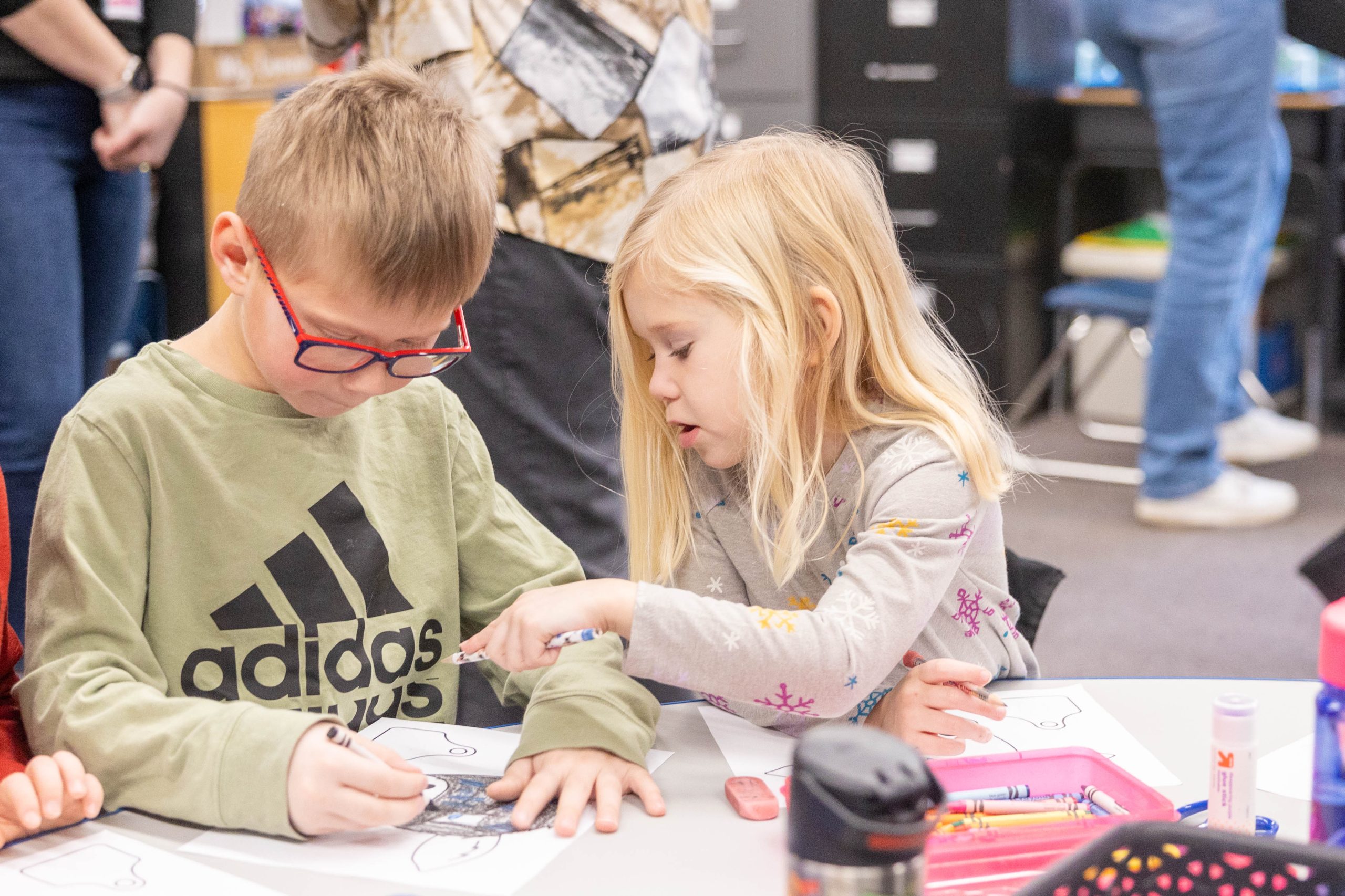
Kindergarten through eighth grade classrooms are invited to participate in grade-specific, hands-on lessons where students can learn agriculture is their source of food, clothing, and shelter. Each lesson is aligned to Nebraska State Education Content Standards for science, social studies, math, or language arts.
Join a Nebraska Agriculture in the Classroom (AITC) Education Specialist for an in-person or virtual lesson to provide students an enhanced learning experience in your classroom. In an ever-changing world, AITC understands every classroom has unique needs. When signing up, please select whether you would like the lesson delivered in-person in your classroom or virtually. AITC prefers to use Zoom to connect virtually but can accommodate many other video-chat platforms!
Who can participate in a Classroom Visit?
- Public Schools
- Private Schools
- Homeschools
By participating in a Classroom Visit, students will:
- Engage in a socially distanced, hands-on activity.
- Understand that agriculture is essential to everyday life
All lessons align to Nebraska State Education Standards.
There is no cost associated with this program.
Materials are provided by Nebraska Agriculture in the Classroom.
Lessons are presented by a professional educator.
Lesson Opportunities
Apples Inside & Out!
This lesson requests 35 minutes of classroom time.
Subject: Social Studies
Nebraska State Standard Connection:
SS K.3.3.b Identify the four seasons.
Sweet, nutritious, and delicious; this lesson illustrates the life cycle and seasonal changes of an apple tree. Students will listen to a sweet story and create their own apple to attach to an apple tree poster while they use their five senses to explore apples. Students will get to eat different apple varieties in this lesson with a taste test.
Click Clack Moo
This lesson requests 35 minutes of classroom time.
Subject: Science
Nebraska State Standard Connection:
SC.K.7.2.B Construct an argument supported by evidence for how plants and animals (including humans) can change the environment to meet their needs.
Learn what it’s like to live on a beef ranch after reading a story about beef cattle. Students will gain knowledge about the environment Nebraska’s beef cattle are raised in and then summarize their new knowledge with the creation of a cow craft.
Corn Castles
This lesson requests 35 minutes of classroom time.
Subject: Science
Nebraska State Standard Connection:
SC.K.7.2.C Use a model to represent the relationship between the needs of different plants or animals (including humans) and the places they live.
What’s all the craze about corn? Students will discover what plants need to survive and explore different types of corn grown in Nebraska and their uses! Students will each plant a corn seed and hang it in the windows of the corn castle!
Found on the Farm, In the Barn, Field, or Pasture
This lesson requests 30 minutes of classroom time.
Subject: Science
Nebraska State Standard Connection:
SC.K.7.2.C Use a model to represent the relationship between the needs of different plants or animals (including humans) and the places they live.
Where are plants and animals found on the farm? The barn, the field, or in the pasture! Students will explore the relationship between the needs of different plants and animals on the farm and discover where plants grow and animals live! Students will create their own mini storybook as they explore where different plants and animals live on the farm.
Each first-grade lesson requests 35 minutes of classroom instruction time.
Farm Animal Match
Subject: Science
Nebraska State Standard Connection:
SC.1.6.2.D Make observations to construct an evidence-based account that young plants and animals are like, but not exactly like, their parents.
What do chicks, calves, lambs, and piglets have in common? They are all farm animal babies! In this lesson students will make observations to discover that animals are like, but not exactly like, their parents. Students will play a card game encouraging students to match farm animals with their young while learning the terminology for males, females, and baby farm animals.
It’s a Moo-stery!
Subject: Social Studies
Nebraska State Standard Connection:
SS 1.4.1.b Compare and contrast family life from earlier times and today. For example: “How was life different for earlier generations?”
How did your ancestors milk their cows? It’s no moo-stery that dairy cattle are cared for every single day. Learn how historical family dairy farms milked cattle compared to today’s current dairy farms! Students will play a matching game and shake up some whipping cream to see how butter is made.
Lunch Around the World
Subject: Social Studies
Nebraska State Standard Connection:
SS 1.3.4.a Identify cultural traits. For example: languages, religions, foods, music, sports, clothing
What’s for lunch in your country? Trace regional cuisines to different cultures around the world and read “How Did That Get into My Lunchbox? The Story of Food.” Students will break into groups to explore seven foods completing a food supply chain.
My Farm Web
Subject: Social Studies
Nebraska State Standard Connections:
SS 1.2.3.a Categorize human and natural resources used to create goods and services.
Have you used agriculture today? In this lesson students will identify goods and services in agriculture and sort human resources and natural resources by creating a visual web to connect the goods to where they are sourced from.
Each second-grade lesson requests 35 minutes of classroom instruction time.
A Slice of Agriculture
Subject: Social Studies
Nebraska State Standard Connection:
SS 2.3.3.c Match resources to their sources. For example: food from farms, wood from trees, minerals from the ground, fish from bodies of water.
Extra cheese, please! Did you know that every ingredient on a pizza can be traced back to the farm? In this interactive lesson, students will explore how farmers and ranchers help supply the demand for our pizza ingredients by creating their very own pizza spinner!
Perfect Pollination
Subject: Science
Nebraska State Standard Connection:
SC.2.7.2.B Develop a simple model that mimics the function of an animal in dispersing seeds or pollinating plants.
What do bats, bees, and birds have in common? Pollination! Pollination is essential in the lifecycle of a plant. Students will explore pollination in Nebraska crops by developing a simple model using their own bag of Cheetos to pollinate their own flower. This lesson is sure to create a buzz in your classroom!
Farming in A Glove
Subject: Science
Nebraska State Standard Connection:
SC.2.7.2.A Plan and conduct an investigation to determine if plants need sunlight and water to grow. Assessment is limited to testing one variable at a time.
Have you ever wondered what makes corn grow so big and tall? In this hands-on activity, students will explore the necessary living environments for Nebraska’s crops and create their own “farm in a glove” for the classroom!
Wad-a-Watershed: Human Environment Interactions
Subject: Social Studies
Nebraska State Standard Connection:
SS 2.3.3.d Describe how people adapt to their physical environment. For example: soil conservation, build levees, grow plants and raise animals.
Discover how water flows and how the actions of everyone – farmers, homeowners, and businesspeople can impact the water resources. Students will develop an understanding of agricultural conservation practices by creating a visual ‘water’ representation of a watershed and identify actions they can take to protect our water supply.
Each third-grade lesson requests 35 minutes of classroom instruction time.
Chicken Little to Chicken Big!
Subject: Science
Nebraska State Standard Connection:
SC.3.9.3.B Analyze and interpret data to provide evidence that plants and animals have traits inherited from parents and that variation of these traits exists in a group of similar organisms.
This egg-cellent activity allows students to identify different breeds of chickens, examine physical traits, and determine how farmers select certain breeds based on inherited traits. This lesson is accompanied by a chicken matching game to help students summarize their learning!
Truth or Hogwash?
Subject: Science
Nebraska State Standard Connection:
SC.3.7.2.C Construct an argument with evidence that in a particular habitat, some organisms can survive well, some survive less well, and some cannot survive at all.
Pigs have a lot more in common with us than you might think- they need air, water, food, and shelter to stay happy and healthy! On farms, farmers work hard to make sure pigs have everything they need to grow and thrive. In this lesson, we’ll dive into what it takes to keep pigs comfortable and cared for. You and your team will become “pig experts” as we explore how different environments affect how pigs live. Then, get ready to put your pig knowledge to the test in our game of “Truth or Hogwash?” Can you tell fact from farm fiction?
Topsy Turvy Soybeans
Subject: Social Studies
Nebraska State Standard Connection:
SS 3.3.3.a Describe how the environment influences human activities and how humans alter the environment to suit their needs. For example: climate, water cycle, soil fertility impact agricultural production, usage of land and energy – land formation impacts transportation and communication, agriculture, transportation, industry, use of natural resources, regulations/practices to protect the environment.
Did you know plants are able to sense their environment and respond accordingly? In this hands-on activity, students will explore how soybeans are grown by farmers in Nebraska, examine how the environment affects soybean growth, and learn the many uses of soybeans! Students will work in groups to plant soybeans, discovering the effects of gravity, sunlight, and water.
Who Grew My Soup?
Subject: Social Studies
Nebraska State Standard Connection:
SS 3.2.4.a Identify local goods and services that could be traded with people everywhere. For example: corn, soybeans, beef, irrigation systems, dry edible beans, art, buffalo hides, fish
Beans, Beef, and Bowls, Oh My! Students will use critical thinking skills to guess the ingredients of a staple Nebraska soup: Chili. They will follow the journey of the source of the food they eat while investigating the processes and people involved in getting food from the farm to their spoon. Students will work together to match ingredients to the goods produced on farms.
Each fourth-grade lesson requests 35 minutes of classroom instruction time.
Beef it Up with Technology
Subject: Social Studies
Nebraska State Standard Connection:
SS 4.2.4.b Discuss how technology has affected the specialization of Nebraska’s economy and surrounding states.
Did you know more cows live in Nebraska than people? Through an interactive game of Beef Trivia game, students will explore the history of Nebraska beef ranches, discover the specialization of farms today, identify ways farmers and ranchers utilize technology to care for their livestock, and recognize the impact beef cattle have on Nebraska’s economy.
Engineering Irrigation
Subject: Social Studies
Nebraska State Standard Connection:
SS 4.3.3.d Describe how humans have adapted to Nebraska’s physical environment and use available natural resources. For example: progression of home construction materials, agriculture, irrigation, introduction of trees, soil conservation, soil, timber, surface water and ground water.
More people = more food! By the year 2050, it is expected that our world population will reach nearly 10 billion! To ensure a stable food supply for humans, farmers must continually improve farming methods. In this hands-on activity, students will explore how farmers use precision agriculture to improve the amount of food grown in even the smallest of fields! Students will work together in groups to engineer a water irrigation activity using cups, straws, and water!
Farm to Fuel
Subject: Science
Nebraska State Standard Connection:
SC.4.4.2.F Obtain and combine information to describe that energy and fuels are derived from natural resources and that their uses affect the environment.
Corn is an A-Maize-ing crop! Popcorn, sweet corn, and candy-corn are some tasty treats-but did you know that corn can also fuel vehicles? In this lesson students will engage in an interactive matching game to discover how corn travels from the farm to local gas stations, all while exploring the hands-on process of ethanol production by creating ‘ethanol’ in a bag. (Just the fermentation process!)
The Nebraska Adventure
Subject: Social Studies
Nebraska State Standard Connection:
SS 4.3.1.c Determine why things are located where they are in Nebraska.
Sandhills cattle and river valley soybeans: Have you ever wondered why things grow and live where they do in Nebraska? In this hands-on lesson, students will slice up fractions of play-doh to discover the soil used around the world to produce food, then compare it to Nebraska’s land to understand the soil, weather, and landforms of each region in the state.
Each fifth-grade lesson requests 35 minutes of classroom instruction time.
Competitive Farming
Subject: Social Studies
Nebraska State Standard Connection:
SS 5.2.6.a Describe how international trade promotes specialization and division of labor and increases the productivity of labor, output, and consumption.
Trade increases competition and lowers prices, but who sets those prices? Predicting the price of the futures market can be both complicated and risky. In this lesson students will learn farmers seek to earn a profit when they sell their crop, markets can influence trade relationships with other countries, and the necessity of keeping positive relationships with other countries who purchase Nebraska commodities. Students will gain an understanding of the futures market and how Nebraska soybean farmers trade and export soybeans in an interactive guessing game using critical thinking and M&Ms.
High-Tech Farming
Subject: Social Studies
Nebraska State Standard Connection:
SS 5.2.4.a Describe the historical role of innovation and entrepreneurship in a market economy.
Did you know that if the world’s farmers would have continued to grow crops at 1961 productivity levels, they would need almost 2.5 billion acres of new farmland to maintain today’s food supply? That is more total land area than the entire United States! In this lesson students will discover technologies used on farms to increase efficiency and decrease environmental impacts. Students will team up to complete an interactive agricultural invention timeline.
From Sun, To Moo, To You!
Subject: Social Studies
Nebraska State Standard Connection:
SC.5.8.2.A Use models to describe that energy in animals’ food (used for body repair, growth, and motion to maintain body warmth) was once energy from the sun.
Eating beef provides humans with many nutrients such as zinc, iron and protein. Did you know that the beef you eat was once energy from the sun? In this lesson students will learn how ruminant animals in Nebraska convert grass into nutrient-rich foods such as beef. They will identify the necessary nutrients in a ruminant animal’s diet by creating their own ration snack and explore the connection between energy that comes from the sun to grow grass and the beef products that are a result of that energy. Students will be provided with cheezits, cheerios, marshmallows, m&ms, and pretzels in this activity.
Soybeans Shape the World
Subject: Social Studies
Nebraska State Standard Connection:
SS 5.2.6.b Explain how trade impacts relationships between countries.
How many miles does food travel to make it to the dinner table? In this lesson, students will explore agricultural commodities from all corners of the globe and trace them to their dinner plate. Students will explore exports in a hands-on trading activity to connect Nebraska soybeans to different regions in the world.
Each lesson requests 40 minutes of classroom instruction time.
DNA Discovery!
Subject: Science
Nebraska State Standard Connections:
SC.6.9.3.B Construct a scientific explanation based on evidence for how environmental and genetic factors influence the growth of organisms.
SC.7.13.5.C Construct an argument supported by evidence for how increases in human population and per-capita consumption of natural resources impact Earth’s systems.
SC.8.9.4.B Gather and synthesize information about technologies that have changed the way humans influence inheritance of desired traits in organisms
Like all living things, every plant and animal used in agriculture has DNA! Signup and let’s extract DNA from strawberries! Plants can be engineered to be more nutritious, more resistant to pests, and even drought tolerant! In addition to extracting DNA, students will match crop cards to the challenges faced in growing them to potential solutions that could be reached with genetic engineering.
Food Systems Feed the World!
Subject: Social Studies
Nebraska State Standard Connection:
SS 8.3.2.c Identify and justify how humans develop major world regions and the impact on human societies. For example: geographic factors that influence international relationships and economic development-trade, communication, transportation, infrastructure
Have you ever stopped to think about how your lunch got to your plate? In this lesson, students will dive into the amazing world of our food system-from the farm fields to the grocery store shelves! You’ll explore all the steps that work together to get food where it needs to go and discover how things like health, culture, and geography affect what people eat around the world. Working together, you’ll take on the big question: if our food system is so advanced, why does hunger still exist? Get ready to think critically, collaborate, and see food in a whole new way!
Sugar Shakedown
Subject: Social Studies
Nebraska State Standard Connection:
SS 6.3.3.b Summarize how early humans utilized and adapted to their physical environment.
The battle of the sugars can be traced back to early civilization. Humans learned to adapt to their physical environment using different plants but producing the exact same product, sugar! In the lesson students will explore sugar production in the United States and compare sugar cane and sugar beet production.
Build a Calf
Subject: Science
Nebraska State Standard Connections:
SC.8.9.4.b Gather and synthesize information about technologies that have changed the way humans influence inheritance of desired traits in organisms.
SC.8.10.5.c Construct an explanation based on evidence that describes how genetic variations of traits in a population increase some individuals’ probability of surviving and reproducing in a specific environment.
Why do some cows have white faces and black bodies while others are solid brown? And how do farmers decide which animals to breed? In this hands-on lesson, students will dive into the science of heredity in beef cattle! You’ll uncover how traits are passed down from one generation to the next and learn to spot the difference between dominant and recessive traits. We’ll also explore how farmers use technology and genetics to raise strong, healthy cattle that can thrive in different environments. Get ready to think like a cattle breeder, make some smart genetic choices, and see how science helps shape the future of farming!
Have you participated in a Classroom Visit? Please volunteer feedback and comments about your recent participation in a Nebraska Agriculture in the Classroom Visit. All feedback is welcome and will help us to improve the program. In addition, stories are an important tool for education and fundraising efforts. Please share your story with us!
